Bluestacks is an American tech company that produces the BlueStacks App Player and other cloud-based cross-platform products. The BlueStacks App Player is designed to enable Android applications to run on Windows PCs and Macintosh computers. The company was founded in 2009 by Rosen Sharma, former CTO at McAfee and a board member of Cloud.com.
Investors include [1] Andreessen-Horowitz, Redpoint, Samsung, Intel, Qualcomm, Citrix, Radar Partners, Ignition Partners, AMD and others. BlueStacks is Sharma’s 8th company, with five acquisitions by Google, Microsoft, Citrix X 2 and McAfee. BlueStacks exited beta on June 7, 2014.
App Player
The company was officially launched May 25, 2011, at the Citrix Synergy conference in San Francisco. Citrix CEO Mark Templeton demonstrated an early version of BlueStacks onstage and announced that the companies had formed a partnership. The public alpha version of App Player was launched on October 11, 2011.[2]
App Player is a downloadable piece of Windows and Mac software that virtualizes the full Android experience. The software is free to download and use after adding a small number of sponsored apps, with the option to instead purchase a $2/month premium subscription.[3] According to company sources, the App Player can run over 96% of the 1.4 million apps in the Google Play Store.[4] It reached the 85 million download mark in April, 2014.[5]
On June 27, 2012, the company released an alpha-1 version of its App Player software for Mac OS.[6] while the beta version was released on December 27, 2012. The Mac OS version of App Player is no longer available for download on their homepage, as support for it was officially dropped in 2014. In April 2015, BlueStacks, Inc. announced that a new version of App Player for Mac OS was in development.[7]
GamePop
GamePop, was launched on May 9, 2013. It uses a subscription model. Users receive over $250 worth of paid games with their subscription.[8] It allows users to play as many as 500 mobile games on TV. On July 23, 2014 Samsung announced [9] it had invested in and was backing GamePop. This brought total outside investment in BlueStacks to $26 million. With an increased stride on improvements to its App Player, BlueStacks, Inc. put GamePop development on hiatus in 2015, with plans to improve the product at a later date.
The PlayStation Portable, Nintendo DS and Game Boy Advance versions of the game are called Need for Speed Carbon: Own the City, set in a fictional city named Coast City with a significantly different storyline and also featuring different AI teammate abilities.[2] In 2009, a version of Own the City was also released on the Zeebo as a pre-installed game.[3]
Gameplay
The gameplay is similar to Need for Speed: Most Wanted and Underground 2, but based upon rival street racing crews instead of individuals. Players run a crew and can hire specific street racers to be in their crew and the active friendly racer is known as a wingman. Each employable street racer has two skills, a racing skill (scout, blocker, and drafter) and a non-race skill (fixer, mechanic, and fabricator). Each skill has different properties from finding hidden alleys/back streets (shortcuts) to reducing police attention. Cars driven by the wingmen are also different; blockers drive muscles, drafters drive exotics and scouts drive tuners (although the first two unlockable wingmen (Neville and Sal) drive cars according to the player's chosen car class at the start of the game). Car classes are Tuners, Muscles, and Exotics, and are associated with their own borough and Boss (Tuners/Downtown/Kenji, Exotics/Fortuna/Wolf, and Muscle/Kempton/Angie).
Players must choose a class when starting Career Mode, which will be permanent throughout the career. Each choice starts in a different district, with corresponding initial car choices and unlocks as the game progresses (there is a test drive option at the beginning). As the game progresses, players may choose from any class of car as the game progresses. Players can also unlock cars that are reserved for Quick Races as the players progress throughout the game and earn Reward Cards.
In Career Mode, races cannot be redone for the same purse; if won, the purse is only $500. It is necessary to plan carefully which cars you will buy and upgrade, to avoid running out of money. There are phone calls, texts and emails to go along with the storyline. Winning races causes new races to show up on the map. All gameplay takes place at night. As in Most Wanted the player can use Nitrous and Racebreaker, which accumulate simply from driving, not from specific skill use to earn them.
Gameplay control methods vary from console to console. The PlayStation 3 and Xbox 360 control steering through the control pad, while acceleration, braking and other controls can be configured and mapped to the different buttons on the controllers. The Driving Force GT and G27 racing wheels can be used, and this is the first Need For Speed title to implement force-feedback and the 900 degree turning radius. On Windows, joysticks and wheel controllers are supported, as well as those that support force feedback. The Wii lacks online play, but fully supports the use of the Wii Remote.
NFS Carbon was the first NFS game to feature online exclusive game modes. Players can upload in-game screenshots to the Need For Speed website, complete with stats and modifications. The Pursuit Knockout and Pursuit Tag game modes are modes that allow the player to play as either a racer or a cop. Pursuit Knockout is essentially a lap knockout with a twist. The racers that are knocked out of the race come back as cops and it’s their job to try to stop the other racers from finishing the race through any means necessary. The player that finishes the race wins. Pursuit Tag begins with one player as a racer and the rest of the players as cops. It is the cops' job to arrest the racer. The cop that makes the arrest then turns into a racer and has to try to avoid the cops. The player who spends the most time as a racer wins.
Race Modes
Unlike Need for Speed: Most Wanted and Underground, Carbon has no drag racing. However, Carbon features the return of drift racing, a mode that had been included in two previous installments Need for Speed: Underground and Underground 2, but omitted from Carbon 's predecessor, Most Wanted. Other familiar race forms return, such as Sprint, Circuit, and "Tollbooth" (renamed "Checkpoint"). There are no Street X or Knockout races, and winning Outruns (renamed "Rival Crew Challenges") is not necessary to complete the game as it was in Underground 2.
Most of Carbon's focus lies through various Canyon Events, based on Japanese Touge races. There are four types of Canyon Events: Canyon Duel, Canyon Sprint, Canyon Checkpoint and Canyon Drift. Canyon Duels have two stages: In the first stage, the player chases the rival and accumulates points faster the closer they stick to the opponent. In the second stage, the roles are reversed and the player's points decline faster the closer the opponent is. If anyone falls behind or is overtaken and passed, without regaining the distance, after ten seconds they lose. You can also lose by going over the cliff edge. Some races have broken, lit-up guardrails which you must be careful not to crash through, and some have solid walls. The Canyon Drift and Canyon Duel are similar to the 2006 film The Fast and The Furious: Tokyo Drift.
In Career mode, players have to race tracks and win to conquer territories, and then face off against bosses to conquer the first three boroughs. To challenge Darius (Boss of the fourth borough) and win the game, you must defeat the three Bosses in two final races and defeat Darius in a Circuit race and a Canyon Duel. Throughout the race, as the player accumulates territories, the minor crews (Black Hearts and Kings, who drive exotics, Inferno and Los Colibres, who drive muscles, and Rotor 4 and Scorpios, who drive tuners), might attack the player's owned races/territories. The player can then either accept the challenge, and keep the race if they win it, or decline, in which case, the minor crew will automatically retake the race, and the territory if too many races are lost.
Carbon also features Quick Races modes (including 2 player) and Reward Cards, in which card pieces are won by achievements in and out of Career Mode. Once a card is fully won, new cars, parts, or other features are unlocked. The Challenge Series is a set of 36 events (12 categories with 3 skill levels). Finishing a Challenge category also unlocks features.
Pursuits
As with Most Wanted, cops are everywhere in Carbon. Police chases can break out at any time, including when in Free Roam mode, when racing, or just after a race is completed. The background music and most of the radio dialogue is the same as in Most Wanted. Canyon Races and Checkpoint Races have no risk of police pursuit. As with Most Wanted, there are 5 conditions/heat levels and players should be careful to avoid getting pursued by state or federal authorities. The Collector's Edition features three additional heat levels.
Although the pursuit system is similar to Most Wanted, this feature has been reprogrammed in Carbon to ensure that police are not too dominant in arrest tactics in high pursuit levels. Unlike in Most Wanted, it is possible to evade the police after running over a spike strip by using nitrous. At the same time, some of the police tactics (such as the spike strips) are used in ways that make pursuits much harder to escape, and the police cars are much harder to disable. Using Pursuit Breakers no longer guarantees the blockage/destruction of every pursuing vehicle. However, police can see you without pursuing if you are not breaking any laws—unless you have a warrant (evaded a previous pursuit).
Customization Features
Need for Speed: Carbonfeatures a new car customization option called "Autosculpt", enabling players to utilize aftermarket car parts and shape/mold the parts to their liking. Players can also have multiple customized vinyls as well, which can be moved, resized, or skewed, which offers unlimited design possibilities.
Performance tuning has been redone so that players, as upgrades are purchased, can tune the car for a number of different properties, such as higher top speed or higher acceleration. Unlike Most Wanted, all of Carbon's performance tuning/enhancing and car customizing is done inside the Safe House. A new "optimize" feature has been added for players who just want the best options without spending too much time tuning and configuring.
Players can choose from many licensed cars divided into three classes as follows: Tuners, Muscles, and Exotics. Each car has its own characteristic ranging from easy cornering to well-balanced road performance. For example, Tuners are good in handling and tight corners, Exotics can rev up to very high speeds, and Muscles can accelerate fast in a short amount of time. In Career Mode, you must choose a class at the beginning, but this does not limit your later car purchases.
Own the City
For portables, the Own the City version has many differences. There are new game modes, like Escape where the player must escape from a rival crew's territory, Delivery where the players and their crew have to deliver a package to a designated area in first place to win, and Crew Takedown, where players have to eliminate a set number of rival racers to win. Crew management allows hiring of up to 5 wingmen per crew, with 2 active for racing. Players can use the crews for all races except for Lap Knockout, Escape and Crew Takedown modes. The city is also divided into many areas, some together into a district owned by one crew, with a total of 6 districts and 13 areas. Every area conquered gives new unlocks and new wingmen. Wingmen also have three different classes; a brawler that takes down racers, a drafter that drafts racers to give speed boosts, and assassins that deliver spike strips the player needs to avoid that can blow a car's tires, aimed for enemy cars. "Own the City" also allows free roaming with crates scattered throughout the whole city that when broken, give special unlocks ranging from cash to game art. Police chases are only available in free roam, and are not available in races.
Plot
Setting
The game is set in the fictitious city of Palmont. There are three major canyons in Palmont: East, West, and Carbon Canyon. The southwestern border of the city features a sea coast. The city also includes several rivers and a lake near Carbon Canyon. It resembles very much to its predecessor Need For Speed: Most Wanted. Palmont is divided into four boroughs at the beginning of the game: Kempton (southeast industrial area), Downtown (east metropolitan area), Fortuna (west residential area) and Silverton (north casino & resort area) ; one for each of the major crews. A highway system extending through the middle of the city is the main connection between the boroughs. All boroughs except Silverton are initially accessible to the player; access to Silverton is unlocked only after beating the crews in the other three boroughs. There is an additional area named San Juan, but similar to the canyons, it's not connected to the boroughs of Palmont. The game is set inside the fictional city of Palmont which exists alongside of Rockport, which was used in Need for Speed: Most Wanted, Bayview, which was used in Need for Speed: Underground 2, and Olympic City, which was used in Need for Speed Underground. Palmont is also featured in the massively multiplayer online racing gameNeed for Speed: World, along with Rockport of Need for Speed: Most Wanted.
Need for Speed: Carbon
After escaping from the authorities in Rockport, the player drives in a BMW M3 E46 GT-R on a canyon route to Palmont City. A flashback of what seems to be a race against Kenji, Angie, and Wolf comes to the player's mind. A police incident at the end of the race forces the player to make a hasty escape from Palmont. In the present day, the player is nearing the city limits of Palmont, when is rammed from behind by a driver in a Chevrolet Corvette Z06. The driver turns out to be former Police Sergeant Cross (Played by Dean McKenzie), now turned into bounty hunter. After a high-speed chase down the canyon, they both run into a construction zone, where Cross then corners the player who has just totaled his BMW. Shortly before Cross can arrest the player, Darius (Played by Tahmoh Penikett) and his crew arrive. Darius pays off Cross, and the player meets up with Nikki (Played by Emmanuelle Vaugier), a former girlfriend, who is apparently unhappy with the player's return.
Darius tells the player to regain control of the different territories in Palmont. Winning races one by one, the player acquires territories and ultimately districts from Kenji (Downtown (Bushido)), Angie (Kempton (21st Street)), and Wolf (Fortuna (TFK)), now crew leaders. After beating each racer, the player meets up with a former member of that racer's crew, who want to join the player's crew and reveal their observations regarding the night the player took off from Palmont.[4]
After gaining control of all three districts, Darius asks the player to meet up with him. He reveals that he was just using the player all along to get more territory, and that he has brought Cross along to arrest the player. Darius leaves the player at the mercy of Cross, but the player is saved by the arrival of Nikki, who tells him that she now realizes everything that happened months ago after piecing together her view of the night and the viewpoints of the other racers.[5] When Darius finds out that Nikki is working with the player, he hires the three previous bosses (Kenji, Angie, and Wolf) into his new crew, Stacked Deck. The player then attempts to conquer Silverton, and oust Darius and his Stacked Deck crew, to exact revenge for Darius' actions.[6]
The player begins to win races against the Stacked Deck, and gets his chance to beat Darius for control of Palmont and to accord justice. After finally defeating Darius, Darius surrenders his Audi Le Mans Quattro to the player. Before he leaves, Darius tells the player to "...enjoy it while it lasts, because there's always someone out there who's a little faster than you are, and sooner or later they're going to catch up...".[7]
Need for Speed: Carbon: Own the City
The player flashbacks to a race where in he, his brother Mick and a couple of other racers are racing to decide who owns the city. But a terrible car crash ruins the competition, leaving the player in the hospital with amnesia and Mick dead. The city is also divided back into different crew territories. Upon waking up, the player is greeted by Mick's girlfriend, Sara and Carter, Mick's wingman, as they visit Mick and help the player return his memories.
The player is set to find out who killed Mick, and goes on different races to beat different crews, regain territory and see if they know anything about the accident, where each crew boss then describes what they know about the accident that killed Mick. The player soon find out that the crash was caused by a kid named Buddy, and after a visit to a crew boss called EX where he explains, Sara is seemingly caught in an explosion. The player is driven further to find out who caused the trouble, and soon confronts Buddy. Buddy then reveals that he was hired, and hands the player his phone. The player continues, and meets MK, an undercover police racer, after defeated by the player, who then helps with his police abilities to find out who planned the murder, through Buddy's phone.
It is revealed that EX was the one who planned the crash, and the player goes after him, with MK's police forces in the end apprehending EX after defeated by the player. Sara appears, and tells the racer to race her, which she in the end reveals the truth: the player hired EX to get rid of Mick due to Mick's monstrous personality that hurt Sara and the player, which EX hired Buddy to crash Mick's car, the "accident" resulting in Mick's death. It was indeed, all along the player's plan, where Sara was promised to be freed from Mick by the player. Sara then hands the player Mick's watch, saying that he is different from Mick, and that she is free, now together with the player.
Soundtrack
By default, hip hop/grime songs are played when the player is driving an exotic car, electronic songs are played when the player is driving a tuner car, and rock music is played when the player is driving a muscle car, though, this setting can be turned off. These songs were released by EA in very limited quantities on a special edition disc. The songs played within the safe house and other game menus, as well as a small number of races were composed by London techno act Ekstrak, and was released widely by EA, and is available from online retailers such as iTunes, as well as hard copies. Other music, most played in major races, such as Race Wars and Canyon Battles have been widely released akin to the Ekstrak release. This actual soundtrack consists of music composed by Trevor Morris, who has gone on to work with Steve Jablonsky for the 2007 EA RTS game, Command & Conquer 3: Tiberium Wars.
The Need for Speed: Carbon Collector's Edition features 4 exclusive cars, 10 pre-tuned cars, 6 new races, 3 unique challenge events, 10 unique vinyls and a Bonus DVD showing the making of Carbon and showcasing all the cars used in the game. The Collector's Edition also features alternate box art and a metallic-finish sleeve encasing the case of the game. Although the Mac edition doesn't display the Collector's Edition title, it contains all Collector's Edition features. The downloaded version of the game features the Ultimate Performance Kit, 2006 Pagani Zonda F and the 1971 Dodge Challenger. An arcade version of the same name was released by EA Arcades in 2008.[1][10] The Collector's Edition is not available for PS3.
Need for Speed: Carbon was met with generally positive reviews. IGN gave the PC version an 8.2 out of 10[40] and the PlayStation 3 version a 7.9 out of 10[41] citing "It's not revolutionary, it's not brilliant, but it's good, deep racing,". GameSpot gave praise for adding more movie clips, customization and solid gameplay but was critical about frustrating boss battles and under utilizing police chases.
Electronic Gaming Monthly gave the game an average score of 8.0.[49]Hyper's Daniel Wilks commends the game for its "large gameworld" but criticises it for its "easy, drift course mechanics suck [and] cutscene 'actors'".[50] The Australian video game talk show Good Game gave the game a 5/10.[51]
Compatibility issues
The unpatched Windows version of the game has compatibility issues when playing under Windows Vista and crashes after the EA Logo screen, however most issues have been resolved in patch version 1.4.[52] according to EA's Website Support page.[53]
PlayStation 3 & Xbox 360 NA November 11, 2014[1] AUS November 13, 2014[2] EU November 13, 2014[3] JP December 11, 2014 Microsoft Windows March 10, 2015[4]
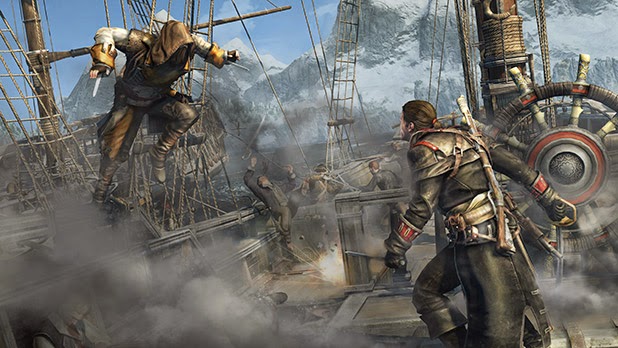
The story is set in the mid-18th century during the Seven Years' War, and follows Shay Patrick Cormac, an Assassin-turned-Templar. Gameplay in Rogue is very similar to that of Black Flag with a mixture of ship-based naval exploration and third-person land-based exploration with some new features.
Gameplay
Naval aspects from previous games return with the player controlling Shay's ship, Morrígan. Morrígan has a shallower draft compared to Edward Kenway's Jackdaw fromAssassin's Creed IV: Black Flag, allowing for river travel.[1][5] New features include new ship-based weapons such as releasing an oil slick which can then be ignited, Puckle guns, and the ability for enemies to board Morrígan during ship-to-ship combat. The arctic environment also features into naval gameplay and exploration, as certain icebergs can be rammed with an icebreaker.[6] The underwater diving missions featured in Black Flag do not exist in the North Atlantic, as swimming causes the player's health to rapidly deplete due to the frigid water.[7]
For combat, the game introduces an air rifle, which allows the player to silently take out enemies at a distance. The air rifle can be outfitted with a variety of different projectiles, such as firecrackers. The player can also use a grenade launcher, which fires off shrapnel grenades and other loads.[5] Hand-to-hand combat has been slightly altered, and now enemy attacks can be countered with timing, similar to the Batman: Arkham series of games. Enemy Assassins feature archetypes similar to previous games, using skills that players have been using throughout the series; they can hide in bushes, blend in with crowds, and perform air attacks against the player.[7] Poison gas can now be used as an environmental weapon, and Shay has a mask that can mitigate its effects.
Side missions and activities return, with a number of them based on those of the previous games. Reflecting Shay's role as a Templar, the game introduces a new side mission: Assassin Interception. These mirror the Assassination side missions in previous games, in that Shay, after intercepting a messenger pigeon carrying an assassination contract, must prevent a Templar agent being assassinated by finding and killing Assassins hidden nearby.
The main character of the game is Shay Patrick Cormac, a twenty-one-year-old recruit to the Brotherhood of Assassins who grows disillusioned with their methods and their cause just as his career as an Assassin begins.[5] He eventually betrays and abandons the Assassins after an assignment ends in disaster, and is later accepted into the Templar Order, offering his services as an Assassin Hunter after seeing some of the Assassins groups used as allies have taken to terrorizing New York. Given access to near-limitless resources, Cormac sets out against his former companions, with his actions having dire consequences for the future of the Brotherhood.[1][6] Cormac has ties to the events that occur in Assassin's Creed Unity.[8] Appearances from previous Assassin's Creed characters include: Haytham Kenway, the secondary antagonist ofAssassin's Creed III;[7]Achilles Davenport, Ratonhnhaké:ton's mentor; and Adéwalé, Edward Kenway's quartermaster in Black Flag, and protagonist of Freedom Cry.[9]
Plot
The Modern Day plot begins one year after the events of Black Flag, with a new unnamed player character that works for Abstergo Entertainment. While investigating the memories of Shay Patrick Cormac, an Assassin working in the North Atlantic during the French and Indian War, they inadvertently trip a hidden memory file that corrupts the Abstergo servers. With the building being put into lockdown, the player is recruited by Melanie Lemay to continue exploring Cormac's memories in an effort to clear the system.
Cormac is a new recruit to the Brotherhood of Assassins, working under Achilles Davenport. Achilles sees potential in him, but Cormac develops an insubordinate streak that frustrates his mentors. Believing that taking a more active role in the Brotherhood's affairs will temper his impetuousness, Achilles orders Cormac with his newly acquired ship the Morrígan to track down a Templar cell that has been deciphering a Precursor artifact revealing the locations of several Pieces of Eden. The artifact, in the form of a wooden box, had been stolen from the Assassins following a massive earthquake in Haiti some years before. With the help of Benjamin Franklin, a Piece of Eden is located in Lisbon, and Cormac is tasked with retrieving it.
However, Cormac has begun questioning the Assassins' motives after seeing their refusal to engage in dialogue with the Templars, and takes no satisfaction from killing an already-dying Templar commander,Lawrence Washington. His doubts come to a head in Lisbon, where his attempt to retrieve the Piece of Eden triggers an earthquake that destroys the city. Noting that similar events occurred in Haiti, Cormac is horrified to learn that Achilles and the Assassins intend to pursue the remaining Pieces of Eden. Cormac steals a manuscript necessary to interpret the artifact and flees, while the Assassins give chase. Confronted at the edge of a cliff in the homestead, he decides to commit suicide and bury the manuscript to the depths of the Atlantic than to let the Assassins reacquire it. Just as he jumps, an Assassin shoots him in the back; Cormac comes to believe it was his best friend Liam's doing.
Cormac is rescued by a passing ship and taken to New York City. Once he recovers, he uses the skills he learned from the Assassins to drive out the city's criminal gangs. His actions attract the attention of George Monro, the city's governor, who offers Cormac the chance to help rebuild the city. Indebted to Monro, Cormac assists the British Army in their early campaigns against the French, and discovers that Achilles' chapter is supporting the French war effort. Monro reveals himself to be a Templar, and despite knowing of Cormac's prior loyalty, offers him a place within their Order. Cormac accepts, but Monro is killed shortly afterwards during an attack on a British fort. Cormac is then formally inducted by the Templar Grandmaster, Haytham Kenway.
Cormac reveals to Kenway his belief that the Pieces of Eden sought by the Assassins are not weapons, but are instead being used to hold the world together, and he pledges to stop his former allies before they cause another catastrophe. His efforts lead to the deaths of several senior figures in the Brotherhood, until only Achilles and Liam remain. Having discovering that the pair are headed for another Precursor temple in the Arctic, he immediately pursues them. Inside the temple, Haytham and Cormac confront Achilles and Liam over their actions, but Achilles' attempts to prevent bloodshed causes Liam to destroy the Piece of Eden by accident, causing another earthquake. While Haytham pursues Achilles, and Cormac and Liam fight throughout the temple, until Cormac ultimately kills his former friend. He arrives in time to persuade Haytham to spare Achilles, as his testimony will stop the Assassins from trying to locate other temples. Haytham nonetheless cripples Achilles as a precaution by shooting him in the knee.
With the Assassin Brotherhood all but destroyed, Cormac is tasked with locating the artifact that was used to find the Pieces of Eden, as Achilles had passed to other Assassins prior to his Arctic voyage. Cormac's twenty year search eventually leads him to Versailles, where he discovers it under the care of Charles Dorian; father of Arno, protagonist of Assassin's Creed Unity. Cormac kills Charles and takes possession of the artifact, taunting the dying man with the promise that while the American Revolution ended Templar influence in the Americas, a new revolution may yet hold promise.
In the present day, the player reconciles Cormac's memories. Under the direction of Otso Berg, a senior Templar leader, they upload them to the Assassin network, revealing how close Achilles Davenport came to destroying the world. The result is almost instantaneous, with the Assassins thrown into disarray and, as revealed in Assassin's Creed Unity, retaliating by hacking into the Abstergo's systems and destroying all of the company's Precursor samples as well as causing several of their servers to melt down. As reward for their actions, the player is presented with a choice; join the Templar Order, or die. The game fades to black before a choice is made.
Development
By March 2014, an Assassin's Creed game code-named "Comet" was revealed to be in development, set for release on PlayStation 3 and Xbox 360.[10] By the end of the month, additional reports indicated that "Comet" would be set around 1758 in New York, as well as feature sailing on the Atlantic Ocean. The game would be a direct sequel to Assassin's Creed IV: Black Flag, and would feature a Templar named Shay as the main protagonist. Haytham Kenway from Assassin's Creed III and Adewalé from Black Flag would also make appearances.[11]
The game was officially announced on August 5, 2014, following a leak of the title.[12] Game director Martin Capel described the game as finishing the series' "North American saga" and that the game was designed to accommodate specific fan requests, such as taking on the role of a Templar.[1] The game is intended to "fill the gaps" of the story between Assassin's Creed III and Assassin's Creed IV: Black Flag and has "a crucial link" to the events of the previous games.[8] In addition to Ubisoft Sofia's work on the game, contributions are also being made by Ubisoft studios in Singapore, Montreal, Quebec, Chengdu, Milan andBucharest.[1] Ubisoft also stated that the game was being envisioned without multiplayer components "at this stage", but did not rule out any modes being added after the game launched.[13]
Assassin's Creed Rogue received mixed reviews. Aggregating review websites GameRankings and Metacritic gave the PlayStation 3 version 74.06% based on 32 reviews and 72/100 based on 52 reviews,[14][18] and the Xbox 360 version 73.13% based on 27 reviews and 72/100 based on 32 reviews[15][19] and the Microsoft Windows version 69.71% based on 7 reviews and 75/100 based on 22 reviews.[16][17]
Ray Carsillo from Electronic Gaming Monthly gave the game a 8.5/10, praising its interesting lead character, enjoyable story, new weapons introduced, new mission design, which requires player to prevent assassinations instead of carrying out assassinations like in other Assassin's Creed titles, as well as advanced and improved combat mechanics. However, he criticized poor pacing of the story, frequent bugs, lack of replayability and the lack of inclusion of a multiplayer mode. He concluded the review by saying that "Rogue is a far more pleasurable experience than I anticipated. It does just enough to put its own stamp on the franchise while also giving us critical story details in order to tie up loose ends between Assassin's Creed III and IV. It serves as a perfect conclusion to the series’ time spent exploring Europe’s North American colonies in the 18th century."[21]
Eurogamer drew comparisons between Rogue and Assassin's Creed Revelations—a game which served to resolve storylines from Ezio Auditore's saga as a lead-in toAssassin's Creed III, due to its focus on expanding on characters and storylines introduced in III and Black Flag. Although noting that some settings, weapons, and mechanics had been reused from previous games in the series (such as an expansion of the New York City setting from III, naval combat, renovating buildings to build income, and locating enemies with a radar similarly to the former multiplayer mode), the use of Assassins as an enemy was considered to be a "much-needed new [idea] to the series' fighting mechanics" due to their use of tactics that were used by the player themselves in previous games (such as smoke bombs and hiding), and that Rogue felt the most "fresh" whilst exploring its new North Atlantic overworld. However, the story missions themselves were criticized for being noticeably shorter than in previous games.[30]
Matt Miller from Game Informer gave the game a 8.25/10. He praised the huge variety of activities, varied environments and mission types, new additions and well-performed gameplay, despite being too similar to its predecessors. He criticized the repetitive melee combat and the absence of multiplayer mode. He described the game by saying that "Rogue is vast with lots to explore, and while it lacks novelty, it offers a wealth of gameplay and lore to faithful fans."[23] Daniel Bloodworth from GameTrailers gave the game a 7.2/10, praising the return of some old characters in the Assassin's Creed series, stunning scenery and environment, interesting interceptions missions, but criticizing the predictable and dull lead character, poorly-constructed missions in the beginning of the game, disappointing boss battles, as well as numerous bugs. He described the game by saying that "Rogue in many ways feels like an extension of last year’s Black Flag, even down to the menus, but there are some tweaks to the formula thanks to your new role as a former assassin, hunting down his old comrades."[26]
Daniel Krupa from IGN gave the game a 6.8/10. He praised the engaging story, the nuanced lead character, atmospheric scenery, but criticized the lack of Templar abilities included, bland encounters with other main characters, uninspired side quests, empty world, as well as the frustrating combat and traversal system, which he stated has shown no improvements. He also criticized the game for not encouraging the player to explore the world.[27] Mark Walton from GameSpot gave the game a 6/10, criticizing the predictable story, unlikeable lead character, lack of interesting missions, as well as being thin on core content. He stated that the game feels like a glorified Black Flag DLC pack and has done nothing to put the franchise forward.[25] Xav de Matos from Joystiq gave the game a 6/10, criticizing the game for not adding anything new to the franchise. He stated that "Assassin's Creed Rogue is essentially a clone of Black Flag's setting and systems. If you can accept rampant copy-and-paste in another full priced entry, you'll more than likely enjoy whatAssassin's Creed Rogue has to offer."[28]
Sales
As of December 31, 2014, Ubisoft has shipped a combined 10 million copies of Assassin's Creed: Unity and Assassin's Creed: Rogue.[31]


 App Player is a downloadable piece of Windows and Mac software that virtualizes the full Android experience. The software is free to download and use after adding a small number of sponsored apps, with the option to instead purchase a $2/month premium subscription.[3] According to company sources, the App Player can run over 96% of the 1.4 million apps in the Google Play Store.[4] It reached the 85 million download mark in April, 2014.[5]
 GamePop, was launched on May 9, 2013. It uses a subscription model. Users receive over $250 worth of paid games with their subscription.[8] It allows users to play as many as 500 mobile games on TV. On July 23, 2014 Samsung announced [9] it had invested in and was backing GamePop. This brought total outside investment in BlueStacks to $26 million. With an increased stride on improvements to its App Player, BlueStacks, Inc. put GamePop development on hiatus in 2015, with plans to improve the product at a later date.