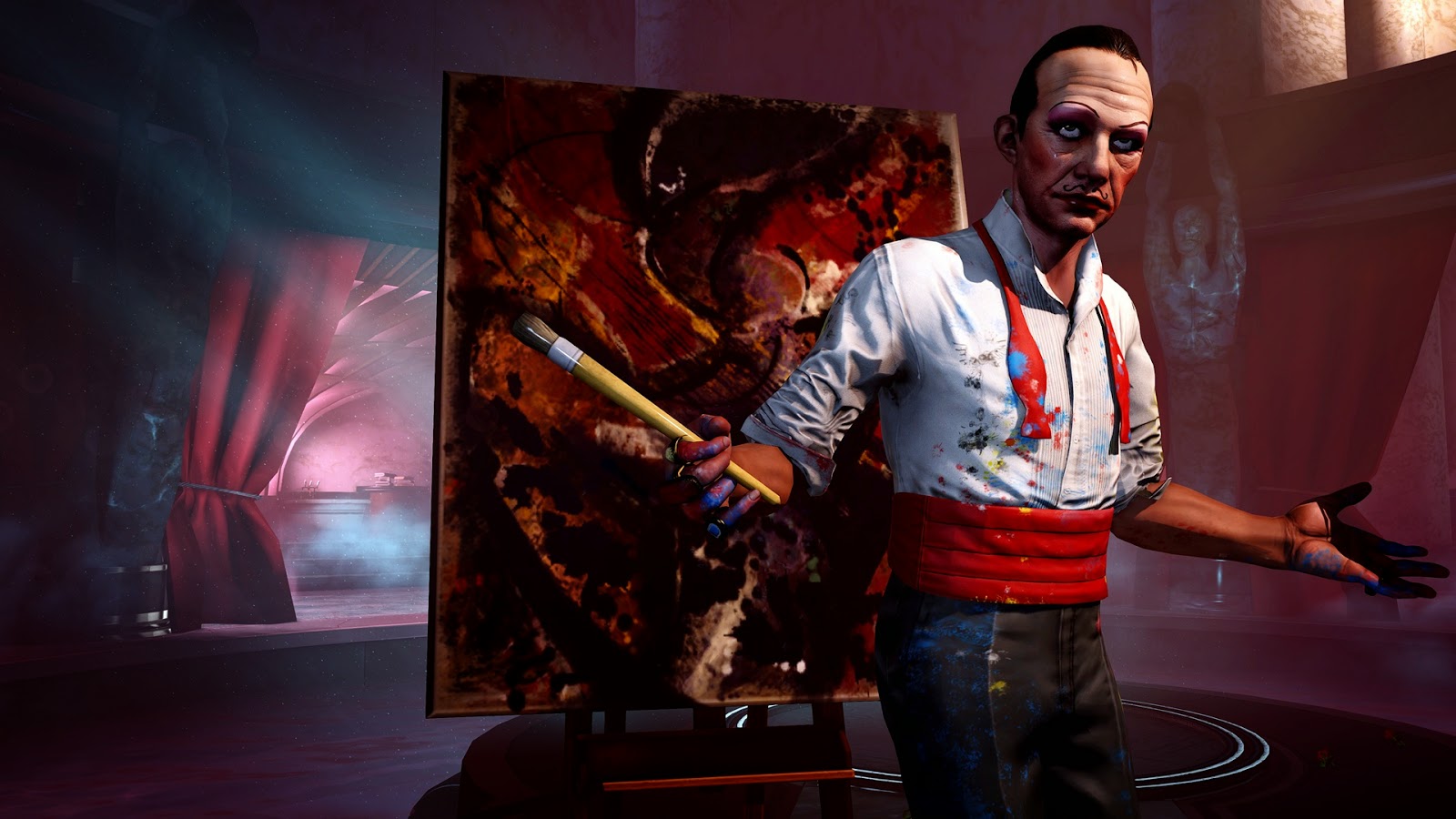
BioShock Infinite is a
first-person shooter video game developed by
Irrational Games and published by
2K Games. It was released worldwide for the
Microsoft Windows,
PlayStation 3, and
Xbox 360 platforms on March 26, 2013; an
OS X port by
Aspyr was later released on August 29, 2013 and a
Linux port was released on March 17, 2015.
Infinite is the third installment in the
BioShock series, and though it is not immediately part of the storyline of previous
BioShock games, it features similar gameplay concepts and themes. Irrational Games and creative director
Ken Levine based the game's setting on historical events at the turn of the 20th century, such as the 1893
World's Columbian Exposition, and based the story on the concept of
American exceptionalism, while also incorporating influences from more recent events at the time such as the 2011
Occupy movement.
Set in 1912, the game has protagonist, former
Pinkerton agent
Booker DeWitt, sent to the floating air city of
Columbia to find a young woman,
Elizabeth, who has been held captive there for most of her life. Though Booker rescues Elizabeth, the two become involved with the city's warring factions: the
nativist and
elite Founders that rule Columbia and strive to keep its privileges for
White Americans, and the Vox Populi, underground
rebels representing the
underclass of the city. During this conflict, Booker learns that Elizabeth possesses strange powers to manipulate "Tears" in the
space-time continuum that ravage Columbia, and soon discovers her to be central to the city's dark secrets.

The player controls Booker Dewitt throughout the game, eventually working with the
AI-controlled Elizabeth. Like previous
BioShock games, the player uses a combination of weapons, clothing called Gears that offer unique attributes, and psychokinetic powers granted through Vigors. Elizabeth's powers can also be used to help fight hostile forces. In contrast to the limited spaces of the underwater city of
Rapture, the openness of Columbia provides for more dynamic combat, including combat that takes place aboard the city's Sky-Line
rollercoaster-like rail system.
Downloadable content for the game includes a story-based mission,
Burial at Sea, that links
Infinite 's story to that of the original
BioShock game.
The game won over 85 pre-release awards for its display at
E3 2011, including
Best of Show from the
Game Critics Awards. At release,
BioShock Infinite received critical acclaim, with praise particularly directed at its story, setting, and visual art design. According to review aggregator
Metacritic, it was the third-highest rated video game of 2013. Within two months of release, it sold over 3.7 million retail copies, and has since sold more than 6 million copies overall.
It won year-end accolades, including
Game of the Year from several
gaming publications.
Synopsis
Setting
 Initially seen as the pride of the United States, tensions eventually rose between Columbia and the American government. In 1901, against the government's wishes, Columbia brutally and violently put an end to the Boxer Rebellion in Peking.[9] This event revealed the floating city as a heavily armed aerial battleship, capable of unleashing devastation across the world.[8] The American government subsequently demanded Columbia's return to sovereign soil, and, in response, Columbia seceded from the United States and disappeared into the clouds, its location soon lost to everyone else.[9] Free from outside influence, Comstock now had complete control over the city, transforming it from a floating world's fair to a theocratic police state.BioShock Infinite
, set in 1912, takes place in
Columbia, a fictional city suspended in the air through a combination of giant blimps, balloons, reactors, propellers, and mainly "quantum levitation."
[4] Named in homage to the
female personification of the United States,
[5] the city of Columbia was founded by self-proclaimed
prophet Zachary Hale Comstock who used his connections in
Congress to have the
American government build it.
[6][7] The government intended Columbia to serve as a floating
world's fair and as a display to the rest of the world of the success of
American exceptionalism.
[8] The city was launched to much fanfare and publicity at the
World's Columbian Exposition in 1893,
[9] and was later dispatched to distant shores, travelling from continent to continent.
[8]

By the time of the game's events, racial tensions have risen to the point where Columbia is on the verge of
civil war, waged between the ruling "Founders" and the insurgent "Vox Populi," two factions with strongly opposing ideologies.
[15] The Founders, led by Comstock, are the prevailing political faction in the city, and are the rulers of Columbia. The city's
ruling class, they are the
racist ultra-nationalists who seek to keep Columbia's privileges purely for
White American citizens while denying the same right to foreigners.
[16] The Vox Populi (Latin for "
Voice of the People"), led by Daisy Fitzroy, are a rag-tag
resistance group who fight to restore the rights of Columbian citizenship to people of all races and religions. However, years of bitter struggle have driven them to fight opposition more out of blind hatred, resulting in more violent and brutal methods.
[17]
In addition to the internal strife, Columbia is ravaged by "Tears" in the
fabric of space-time.
[18] Being the result of past scientific experiments, these Tears reveal
alternate universes, and allow for interaction with them.
[19] While most Columbian citizens regard these Tears as mere curiosity, some individuals have exploited the insight offered by them to create radically new weapons and technologies,
[20] while several others have replicated futuristic music and songs heard from the Tears,
[21] bringing
anachronistic elements into the Columbia of 1912.
[22]
As with
BioShock and
BioShock 2, the player is able to locate audio logs – Voxophones – and film projectors – Kinetoscopes – that will expand on the history and nature of Columbia beyond those events occurring within the game.
[23] Though the game takes place before the events of the previous two
BioShock games (occurring in 1960 for
BioShock and in 1968 for
BioShock 2), the question of whether
Infinite occurs within this same timeline remains unanswered.
[24]
Characters
 "Father" Zachary Hale Comstock (Kiff VandenHeuvel), the main antagonist, is the founder of Columbia and the leader of the elite Founders who rule the city.[6] Revered as "the Prophet" in Columbia, Comstock has maintained his power in the city through a powerful cult of personality based on Christianity and the Founding Fathers of the United States.[10][27] The Founders are opposed by the Vox Populi, led by Daisy Fitzroy (Kimberly Brooks). Initially the servant housemaid for Comstock's house, Fitzroy fled after she was framed by Comstock for the murder of his wife.[28] Shortly after her escape, she formed the Vox Populi and became its leader due to her hatred of the Founder's ways.[29]
The player controls protagonist
Booker DeWitt (
Troy Baker), a disgraced member of the
Pinkerton National Detective Agency emotionally scarred from the acts of violence he committed at the
Battle of Wounded Knee.
[25] Faced with mounting gambling debts, he is sent to Columbia to rescue
Elizabeth (
Courtnee Draper), a young woman imprisoned there since childhood, who has the ability to open Tears.
[8][26] Her confinement has been maintained by Songbird, a large, robotic bird-like creature who has been both her friend and her warden, and which has been programmed to feel betrayal should Elizabeth attempt to escape.
[26]
Robert (Oliver Vaquer) and
Rosalind Lutece (
Jennifer Hale) are two mysterious individuals that direct Booker to Columbia and appear throughout his travels. Though they appear as twins, they are revealed to be the same person but from two different realities, having managed to figure out how to communicate and subsequently cross through realities. Rosalind is shown to be the one behind the technological wonders that keep Columbia afloat.
[30][31]
Plot
In 1912, Booker DeWitt is taken by Robert and Rosalind Lutece to an island lighthouse off the coast of
Maine. Told to "bring us the girl and wipe away the debt," Booker enters a lighthouse, doubled as a rocket silo, which transports him to Columbia.
[32]

Booker is soon pursued by the city authority when he is found bearing a scar of the letters "AD," matching the description of the foretold "False Shepherd" who will corrupt Elizabeth and overthrow Columbia.
[33][34]Freeing Elizabeth from her tower, Booker narrowly evades her captor, "Songbird." Reaching an airship, Booker promises to take Elizabeth to
Paris; when she realizes they are going to
New York City to wipe Booker's debt, a tearful Elizabeth knocks him out. Booker awakes to find the airship under the control of Daisy Fitzroy and the Vox Populi, who offer to return the ship if Booker recovers a weapon shipment.
After finding Elizabeth, Booker becomes her protector. Elizabeth demonstrates her ability to open Tears, but grows disturbed by the damage on Booker, Columbia, and the world in general created by her alterations of reality. An opened Tear leads them to a world where Booker is a
martyr of the Vox Populi whose "sacrifice" sparked open warfare between the Founders and the Vox Populi. When confronted with an alternate reality of a "living Booker" Fitzroy, convinced that he is "either an impostor, or a ghost," turns her forces against Booker in attempt to re-establish the preferred narrative. With Booker's help, Elizabeth kills Fitzroy to prevent her from executing a Founder boy.
As they attempt to leave by airship, Songbird attacks the duo and they crash back to Columbia. Continuing onwards, they unravel a conspiracy behind the city's founding: Zachary Hale Comstock had the Lutece twins construct a "Siphon" device to inhibit Elizabeth's powers; Elizabeth is Comstock's adopted daughter, whom he plans to groom into taking over after his death; and Comstock plotted to kill his wife and the Luteces to hide the truth. After Elizabeth is captured by Songbird, Booker pursues but is brought into the future by an elderly Elizabeth; she explains that, since Booker did not stop Songbird, she suffered decades of torture and brainwashing, inheriting Comstock's cause and waging war on the world. Explaining that Songbird always prevented his previous rescue attempts, Elizabeth begs Booker to stop Songbird with his song and returns him to his present.
[35]

Booker reaches present Elizabeth, and the pair pursue Comstock to his airship. Comstock demands that Booker explain Elizabeth's past to her; an enraged Booker drowns Comstock. Booker denies knowledge about Elizabeth's missing little finger, but she asserts that he has simply forgotten. Controlling Songbird, the pair fend off a Vox Populi attack, before ordering Songbird to destroy the Siphon. As Songbird turns on Booker again, Elizabeth's powers fully awaken, allowing her to open a Tear and transport them to the underwater city of
Rapture.
[b] Booker and Elizabeth materialize inside the city, from where they see Songbird crushed outside by the water pressure.
[36]
Elizabeth takes Booker to the surface lighthouse, explaining there are countless alternate lighthouses and versions of Booker and Elizabeth; they are within one of infinite possible realities dependent on their choices.
[37] She shows that on October 8, 1893, Robert Lutece approached Booker on behalf of Comstock, requesting that he "give us the girl and wipe away the debt," referring to Booker's infant daughter, Anna DeWitt – Booker's "AD" branding. Booker reluctantly agreed, but soon gave chase; arriving as Comstock barely escaped through a Tear, its closing severed Anna's finger. Comstock then raised Anna as his own daughter, Elizabeth, and due to her severed finger, her existing over two realities simultaneously allows her to create Tears and move between them.
[38] Robert Lutece, angry at Comstock's actions, convinced Rosalind to help him bring Booker to the reality where Columbia exists to rescue Elizabeth.
[31][38]

Elizabeth explains that Comstock will always remain alive in alternate universes, as the Luteces have enlisted different universe Bookers numerous times to try to end the cycle.
[35] As stopping Comstock requires intervening in his birth, Elizabeth takes Booker back in time to a baptism he attended, in the hope of atoning for the sins he committed at Wounded Knee; she explains that, while Booker changed his mind, some alternative Bookers accepted the baptism and were reborn as "Zachary Comstock."
[35] Comstock, later aware of his connection to Booker and sterility from overusing the Lutece Tear machine, abducted Anna to provide a biological heir for Columbia. Booker, then joined by other universe Elizabeths at the baptism, allows them to drown him, preventing his baptismal choice and thus preventing Comstock's existence. One by one, the Elizabeths begin to disappear, the screen cutting to black on the last.
[38]
In a
post-credits scene, a Booker
[c] awakens in his apartment on October 8, 1893. He calls out for Anna and opens the door to her room before the screen cuts to black.
[38]
Gameplay
Like
BioShock and
BioShock 2,
BioShock Infinite is a
first-person shooter with
role-playing elements. In contrast to the limited spaces of Rapture in previous
BioShock games, the expanded environment of Columbia provides for more dynamic combat challenges in
Infinite.
[39] As Booker, the player must fight their way through Columbia using weapons and a variety of tools in order to complete objectives. The player may carry only two weapons at a time,
[40] and can collect other weapons and ammunition either from defeated enemies or from random locations around the city.
[41] In addition to his health, Booker is also equipped with a shield. When damaged, the shield regenerates after a few seconds, while health can be replenished with medical kits or food.
[42] Should Booker die, the player revives in a safe area but loses a slight amount of money; Booker regains partial health and is granted additional ammunition, while local enemies are also partially healed. Players can still recover from death should they lose all their money.
[43]

Booker gains powers and abilities through Vigors, Gears, and Infusions, all scattered around Columbia. Vigors, the equivalent of
BioShock 's Plasmids,
[44] grant activated powers such as creating shockwaves, releasing bolts of electricity, and machine/human possession.
[45] Vigors require Salt, the equivalent of
magic points or
BioShock 's EVE, for powering their abilities.
[46] Salts can be found throughout Columbia,
[41] and are also granted upon death.
[43] Wearing Gears grant passive abilities that can improve the player's strength or damage resistance, similar in function to
BioShock 's Tonics.
[44] Each piece of Gear attaches to one of four specific slots: Hats, Shirts, Boots, and Pants. Only one piece of Gear can be affixed to a slot at a time; any extra Gear is stored in the player's inventory.
[41] Infusions grant the ability to permanently boost the player's health, Salts or shield meter by one stat; they also fully restore whatever is being boosted.
[41]
At certain points throughout the story, the player will be forced to make a choice in order to continue, each choice making minor changes on the story. For example, at a raffle at the start of the game, Booker wins and the raffle is revealed to be a front for a public stoning of an interracial couple. As a reward for winning the raffle, Booker is given the very first throw, and the player is given a choice to throw at the couple or at the announcer. If the player chooses the latter option, the couple appears later to thank him for sparing them.
[47]

Once reunited with Elizabeth, the player must work with her to escape Columbia. The player does not directly control Elizabeth, but instead she reacts to the player and the current situation in a manner similar to the AI Director in Left 4 Dead.[48] Unlike BioShock, where the player is tasked with protecting a Little Sister while escorting her,[52] Elizabeth requires no protection and can take care of herself in combat.[49] While the player is in battle, Elizabeth scavenges the area for supplies such as ammunition, medical kits, Salts, and other items, and tosses them to Booker as needed. She can also use her Tear-opening powers to aid the player, bringing in weapons, health, Salts, environmental features such as cover or a ledge for higher ground, and automated defense units. Only one Tear can be opened at a time, making the player decide between the available options to suit the battle.[26][53] Elizabeth also has the ability to pick locks using her hairpin. However, she requires "one-use" lockpicks, found all over Columbia, to open doors or safes storing valuable or hidden items.[54]Booker can traverse Columbia both on foot and by riding the "Sky-Line." The Sky-Line is a
roller coaster-like rail-based system — originally designed for moving cargo around Columbia but later used for personal transport — whereupon the player activates a wrist-mounted tool — called the Sky-Hook — that Booker and enemies wear to jump and hang onto the self-powered tracks. The player can jump onto, off of, and between Sky-Line tracks at any time, and may face enemies that use the system to attack; the player can use one-handed weapons in Booker's free hand while using the Sky-Line. Freedom of movement along the Sky-Line allows for several varieties of combat, including flanking, cover, and area-of-effect attacks through creative uses of the system.
[48][49][50] Booker can also dive off from the Sky-Line to strike enemies with his Sky-Hook; while on the ground, he can melee and execute enemies with it.
[51]

While exploring Columbia, the player and Elizabeth can find various useful items such as cash, food, medical kits, ammunition and Salts.
[55] Vending machines, present throughout Columbia, can be used to buy supplies, and powerful upgrades for weapons and Vigors.
[56] Optional
side-missions are also available, where the player must unlock safes or decode hidden ciphers; completing them rewards Booker with a handful of supplies, Voxophones and Infusion upgrades.
[57]
As the player progresses through the city, he is opposed by various enemies, classified into three types: Standard Enemies, Heavy Hitters and Basic Security Automata. Standard Enemies are regular foes consisting of several different human forces representing the Founders and the Vox Populi.
[58] Heavy Hitters are more formidable enemies, aligned with the Founders, who act as
mini-bosses throughout the game, demanding new tactics from the player.
[59] They consist of: the Vigor-powered Fireman and Zealot of the Lady, the heavily armored Beast, the powerful robotic-like monster Handyman, the
crank gun-wielding automaton Motorized Patriot, and the enemy-detecting Boys of Silence. The Vox Populi also possess their own versions of the Fireman, Beast and Motorized Patriot. Basic Security Automata are armed machines scattered throughout Columbia that act as a security defense system for the city, consisting of the fixed Gun and Rocket Automatons, and the flying Mosquito.
[58]
After completing the story mode on Easy, Normal, or Hard difficulties, a "1999 Mode" is unlocked, where the challenge of the game is significantly increased. Enemies are much tougher, the player's navigational aid and aim assist is removed, and resource management is much more crucial to survival; also, the difficulty of the game cannot be changed while playing. Additionally, in this mode, reviving after dying uses up more money; should Booker die with less than $100, the game ends, and the player is sent back to the main menu and has to resume from their last autosave prior to the section where they died.
[60][61] Alternatively, 1999 Mode can simply be unlocked by inputting a secret code — the
Konami Code — in the main menu.
[62] The mode is a callback to
System Shock 2, a video game developed by Irrational Games, released in 1999.
[63]
Development
 During the initial stages of development, Irrational originally considered several settings for the game, including reusing Rapture or setting the story in the Renaissance period, before finally deciding on the floating city of Columbia.[74][75] The decision to set the game in Columbia originated after the developers and Levine read Erik Larson's 2003 non-fiction book The Devil in the White City, which prominently featured the World's Columbian Exposition set in Chicago during 1893.[76] The time period at the turn of the 20th century and the historical events surrounding it, such as the World's Columbian Exposition, inspired the game's setting as a city in the sky,[77] while the concept of American exceptionalism, which the World's Columbian Exposition was considered to have symbolized, later inspired the game's story and setup.[78] The game also incorporated influences from more recent events at the time such as the Occupy movement in 2011,[79] and several films such as David Lynch's Blue Velvet and Stanley Kubrick's The Shining.[80]BioShock Infinite
 was developed by
Irrational Games and published by
2K Games, with
Ken Levine working on the game as the creative director and lead writer.
[64] Irrational and Levine, who had previously developed the original
BioShock, passed on the opportunity to work on the sequel
BioShock 2 in favor of a new
BioShock game with a different setting,
[65] with
Take-Two Interactive allowing them the freedom to develop it.
[66] Work on
Infinite began in February 2008,
[67] with the game's concept being formed six months after the original
BioShock 's release.
[68]Under the moniker "Project Icarus,"
[69] Irrational worked in secrecy on
Infinite for two-and-a-half years prior to its announcement on August 12, 2010.
[70] The game's development took about five years, with it finally announced as
going gold on February 19, 2013.
[71] Irrational's work on the game required a team of about 200 people,
[72] while also receiving substantial assistance from developer company
2K Australia, which was formerly part of Irrational Games.
[73]
Central to the game was the relationship between the
player character Booker and the AI companion Elizabeth.
[81] Unlike
BioShock 's
Jack and
BioShock 2 's
Subject Delta, both of whom were
silent protagonists,
BioShock Infinite 's protagonist Booker was given his own voice and identity.
[82] Elizabeth, a crucial element of the game, was designed as a character which could not only be a useful AI companion to the player but a real partner with a significant emotional bond as well.
[83] Elizabeth's development was inspired by the character
Alyx Vance, who was described by Levine as a central element and an "emotional driver" of
Half-Life 2.
[84] For the story, Levine took a novel approach by bringing the voice actors for Booker and Elizabeth, Troy Baker and Courtnee Draper, respectively, into the studio to develop their characters and help refine the story.
[85] Levine, however, did not provide the actors with full knowledge of the story in order to help them develop their characters' relationship in a much more natural manner.
[86]
 BioShock Infinite
 runs on a heavily modified
Unreal Engine 3, with additions and replacements on the core engine.
[87] Irrational had initially considered using the heavily modified
Unreal Engine 2.5 used for the original
BioShock, but it was deemed inadequate for their vision.
[88] According to Levine,
Infinite was designed and developed from scratch, with none of its assets taken from previous
BioShockgames.
[89] In terms of gameplay, Irrational designed the vertical and open-air spaces of Columbia to provide more opportunities to include various types of combat compared to the close-ranged limits of Rapture within the original
BioShock.
[39] As the game neared publication, numerous materials such as Vigors, Tear mechanics, weapons, locations, characters, and other enemies, were cut from it, with claims that enough material for five or six games had been scrapped during this process.
[75] Several members of the Irrational staff also departed near the end of the game's development, with their roles filled by replacements.
[90][91]
Levine stated that the performance issues faced by the Windows version of previous
BioShock games had been addressed by Irrational in
Infinite. He further added that the Windows version, enabled by
Steamworks, would not use additional
digital rights management software such as
Games for Windows – Live or
SecuRom.
[92] The retail Windows version would ship on three
DVD discs to accommodate higher-resolution textures beyond the consoles versions, and would support video cards capable of running
DirectX 11 in addition to
DirectX 10, allowing for further graphical improvements to the game.
[93] Irrational also addressed another issue faced by the original
BioShock, in that the PlayStation 3 version of
Infinite would not be a
port and was being developed in-house simultaneously with the Windows and Xbox 360 versions.
[94]In addition, the PlayStation 3 version would support
stereoscopic 3D and the
PlayStation Move motion controller, and would also include a free copy of the original
BioShock in North America.
[95][96]
 BioShock Infinite
 was released worldwide for the
Microsoft Windows,
PlayStation 3, and
Xbox 360 platforms on March 26, 2013.
[97] Aspyr later published and ported
Infinite to the
OS X platform which was released on August 29, 2013.
[2][98] Two major pieces of
downloadable content have since been released by Irrational for the game. The first piece is
Clash in the Clouds, a non-story arena-based combat mode where the player is faced with increasingly difficult waves of enemies on various maps based on in-game settings. It was released on July 30, 2013.
[99] The second piece is
Burial at Sea, a story-based
expansion set in Rapture that links
Infinite 's story to that of the original
BioShock game. It consists of two
episodes, with the first one released on November 12, 2013, and the second one on March 25, 2014.
[100][101] BioShock Infinite: The Complete Edition, bundling
BioShock Infinite with
Clash in the Clouds and
Burial at Sea, was released on November 4, 2014.
[102]
Music
The original score for
BioShock Infinite was composed by
Garry Schyman, who had previously composed both the scores for
BioShock and
BioShock 2.
[103] Ken Levine stated that
Infinite 's score was different compared to that of the previous games in the series, in that it was "sparer" in "instrumentation and the style." He felt that the game had a "much more of an American feel to it," and added that team wanted "a bit more of a
frontier feel to it, slightly." Levine went on to comment that the score was partly inspired by
Jonny Greenwood's score for
There Will Be Blood, which served as a "good" starting point, and
Paul Buckmaster's score for
12 Monkeys.
[104]

From the very beginning during development, Schyman opted for a completely fresh approach to the score for
Infinite due to its differences with previous
BioShock games.
[105] He said that compared to the previous games,
Infinite 's world and time period were "completely different and unique in nearly every respect," and that it was "much more fleshed out in terms of the characters" with story being driven by the two main protagonists.
[104] Schyman noted that he worked on the score over an extended period of time, and due to the game's long and evolving development cycle, it took longer to find the right approach to the score.
[106]After much experimentation, Schyman found that using a simpler musical score was best for the game as he felt that it was consistent with the simpler time of 1912.
[104] However, Schyman stated that he did not limit himself to the
music of the period,
[104] and added that while the game's setting of 1912 was very influential, it was not determinative. He said, "I did not wish to imitate the popular music of 1912 which is not particularly emotional to our ears in 2013."
[106] Originally working with a more
orchestral approach, Schyman later used very intimate small
string ensembles with anywhere from three to ten players to compose the game's relatively simpler score.
[104] Schyman also called Elizabeth a critical element to the music, explaining that "a lot of the music relates to her and some of the emotional things that she's going through." He went on to describe
Infinite 's music as "more of an emotional score" as it was about the relationship between the two key characters in the game, Booker and Elizabeth.
[105]

Levine stated that choosing the
licensed music for
Infinite was much more challenging compared to the original
BioShock.
[107][108] He commented that with the original
BioShock, set in 1959 in the mid 20th century, it was easy to acquire musical pieces representative of the era, with him saying that the team "had this huge slate of great music to choose from."
[107][108] Levine stated that with
Infinite, however, it was set in 1912 in the early 20th century, which had music he described to be "awful" and "not very listenable" to the "modern ear." Consequently, the development team had to "dig really deep" and research extensively for more satisfactory music in
Infinite 's time period.
[107][108] Levine noted that he was not strict with selecting the music and songs that was accurate to the game's time period, as he felt that the most important thing with regards to the music was "that you get people to feel things." He added that the game's fictional nature justified him and the team "play[ing] a little fast and loose" and "[doing] things a little differently" with the music.
[107] Levine also stated that
Infinite 's music would play a "strange role" in the game; he explained that the music would "tie into the macro story, to some degree," and that the team had "a lot of little stories" to tell about it.
[107][108]
BioShock Infinite 's soundtrack, original music, and songs received numerous accolades. The game won for Best Song in a Game ("
Will the Circle Be Unbroken?" performed by Courtnee Draper & Troy Baker) and was nominated for Best Soundtrack at the VGX 2013.
[109] It later won for Outstanding Achievement in Original Music Composition at the 17th Annual D.I.C.E. Awards,
[110] and won for Best Music in a Game at the 3rd Annual New York Videogame Critics Circle Awards.
[111] The game also won for Song Collection at the 2013 National Academy of Video Game Trade Reviewers Awards,
[112] and won for Original Music at the 10th British Academy Video Games Awards.
[113] The game won three awards at the 12th Annual Game Audio Network Guild Awards for Music of the Year, Best Original Instrumental ("Lighter Than Air"), and Best use of Licensed Music.
[114]
Reception
Pre-release
One week after its announcement,
BioShock Infinite was exhibited at
Gamescom 2010, where it received its first awards there, winning IGN's Game of the Show and Best Xbox 360 Game awards.
[115] It was nominated for Most Anticipated Game at the
2010 Spike Video Game Awards,
[116] though it did not win.
[117] Infinite was on display for the general video game audience at the
Electronic Entertainment Expo 2011 (E3 2011), where it was heavily awarded, winning over 85 editorial awards,
[8] 39 of which were Game of Show.
[118] Most notably at E3 2011, the game won all four nominations it received from the
Game Critics Awardsfor
Best of Show,
Best Original Game,
Best PC Game, and
Best Action/Adventure Game.
[119] For the second and third consecutive times,
Infinite was again nominated for Most Anticipated Game by the
Spike Video Game Awards in
2011 and
2012.
[120][121] The game also received two consecutive
Golden Joystick Award nominations for One to Watch in
2011 and
2012.
[122][123]
Critical reception
BioShock Infinite received critical acclaim upon release, with reviewers particularly praising the story, setting and visual art design. Aggregating review website
GameRankings gave
BioShock Infinite an average rating of 96% based on 17 reviews for the PlayStation 3 version,
[124] 93% based on 39 reviews for the PC version,
[125] and 92% based on 27 reviews for the Xbox 360 version.
[126] Metacritic gave the game a score of 94/100 from 27 critics for the PlayStation 3 version,
[127]94/100 from 68 critics for the PC version,
[128] and 93/100 from 33 critics for the Xbox 360 version,
[129] with all three platform versions of the game considered to be of "universal acclaim." According to Metacritic,
BioShock Infinite was the third-highest rated video game of 2013 across all platforms, behind
Grand Theft Auto V and
The Last of Us.
[141]
Consensus among several critics was that
BioShock Infinite was one of the best games of the
seventh generation era of video game consoles,
[133][142][143] with
IGN's Ryan McCaffery praising the game as "a brilliant shooter that nudges the entire genre forward with innovations in both storytelling and gameplay."
[135] Joe Juba of
Game Informer stated that
Infinite was among the best games he had ever played,
[132] while
PlayStation Universe's Adam Dolge called it "one of the best first-person shooters ever made."
[144] Identifying it as a "masterpiece that will be discussed for years to come," Joel Gregory of
PlayStation Official Magazine concluded that
Infinite was the latest game to join the hallowed ranks of
Half-Life,
Deus Ex and
BioShock as "the apotheosis of the narrative-driven shooter."
[137] Even the usually acerbic
Zero Punctuation critic Ben "Yahtzee" Croshaw named it the best game of 2013, saying that he was still thinking about the game's ending months after having played it.
[145]
Wide acclaim was directed to the story, with several critics calling it among the best in video gaming.
[136][151][152] The story's exploration of mature themes was well received,
[134][153] with
Time 's Jared Newman praising its ability to prompt commentary and critiques from players as the game's true value.
[154] Several critics, including
Adam Sessler of
Rev3Games, also praised
BioShock Infinite 's storytelling, noting that its ability to finesse player agency and interaction resulted in a narrative that could only work in a game.
[155][156] The story's
twist ending was mostly praised,
[132][136][155] with several critics predicting that it would provoke debate, and that it would leave a deep impression on players, prompting them to replay the game.
[60][134][140][151] It was also generally agreed that
Infinite 's ending was an improvement over the original
BioShock 's,
[135][146] with Gregory explaining that, unlike its predecessor,
Infinite never lost momentum after revealing its twist.
[137] Some critics who overall praised the ending did concede that it suffered from plot holes and leaps in logic,
[144][157] with
Edge calling it "a finality that doesn't make sense within the universe the game has created."
[130]Several articles have since been released attempting to explain the game's ending.
[30][35][38][158]
Critics particularly acclaimed the city of Columbia as the setting of the game, with Arthur Gies of
Polygon stating that it was "one of
BioShock Infinite 's greatest assets."
[159] Columbia was praised by some critics as one of video games' best settings,
[131][135][153] with
Destructoid's Jim Sterling explaining that, unlike
BioShock 2,
Infinite made a wise decision in abandoning Rapture "for an all new story in an all new setting, introducing us to the cloud city of Columbia."
[146] The setting's visual art design drew praise, with Columbia being described as beautiful and gorgeous.
[135][146] Lucas Sullivan of
GamesRadar went on to describe
Infinite as "one of the most visually captivating games ever made."
[133] The setting's attention to detail was also well received,
[147][155] with critics impressed at how diverse the game's environments were, and how no two of Columbia's many different areas ever felt alike.
[133][135] Critics also enjoyed how the game encouraged them to explore more of Columbia,
[144][160] with Juba explaining "whether you’re looking at a piece of propaganda, listening to an audio log, or participating in a horrifying raffle, almost everything you encounter contributes to your understanding of the floating world."
[132]
Elizabeth's role in the gameplay and narrative received wide praise.
[135][157] Her implementation as an AI partner for the player-controlled Booker was described by Sullivan to be "downright ingenious,"
[133] and was stated by some critics to be the main aspect that separated
Infinite from its predecessors.
[131][135] Special praise was given not only to Elizabeth's ability to take care of herself in combat, but also for actively assisting the player by finding ammo and health, and opening Tears.
[132][133] Critics also acknowledged Elizabeth as not just a combat partner, but a companion that invoked an emotional response from the player.
[131]Eurogamer's Tom Bramwell felt that the game "creates a familial bond" between Elizabeth and the player,
[60] with Sullivan stating that she felt like "a friend."
[133] McCaffrey explained that Elizabeth's presence in the game provided motivation and emotional depth, something he believed the original
BioShock lacked.
[135] Edge called Elizabeth "a technical triumph, the most human-seeming AI companion since
Half-Life 2 's Alyx Vance,"
[130] with Sullivan stating that her "behavior makes you forget she's a video game character."
[133] Several critics also praised Elizabeth's relationship and interactions with Booker, believing that they formed the core of the game's story.
[146][156] Mikel Reparaz of
Official Xbox Magazine explained that "the evolving interplay between [Elizabeth] and Booker is the heart and soul of what makes
BioShock Infinite such an involving, memorable experience."
[138]
The voice cast was well received,
[136][147] with Troy Baker and Courtnee Draper being particularly praised for their performances as Booker and Elizabeth, respectively.
[161][162] The audio and soundtrack also received positive responses,
[132][147] with
Cheat Code Central's Josh Wirtanen stating, "from the absurdly talented voice actors to the so-happy-it's-actually-creepy music selection to set the mood, this game sounds fantastic from start to finish."
[163]
Although the gameplay's combat was mostly well received and praised,
[132][134][155] it was the most polarizing aspect of the game, with
The Daily Telegraph 's Tom Hoggins noting "the gunplay is far from
Infinite 's most satisfying component."
[156] Nevertheless, critics opined that the game's gunplay and shooting was an improvement over its predecessors.
[153][163] The game's expanded environments were well received,
[137]with
Edge noting they encouraged the player to think more tactically and improvise.
[130] Tom Francis of
PC Gamer and Hoggins felt that
Infinite 's overall combat was on improvement over the previous
BioShockgames largely due to the dynamism of the expanded environments.
[139][156] The addition of the Sky-Line received special praise from critics.
[135][155] Sullivan felt that the Sky-Line "delivers a new FPS experience entirely,"
[133] while Gregory hailed it as a "real game-changer."
[137] Critics also enjoyed the Vigors, weapons, and upgrades,
[132][134] with McCaffrey praising the game's "myriad combat options."
[135]
In contrast, the gameplay was criticized by some as monotonous and repetitive,
[157] with
VideoGamer.com's Steven Burns explaining the game's lack of real sense of escalation in either abilities or enemies made combat very tiresome and grating.
[140] Some also noted that
Infinite had regressed into a simple shooter compared to the role-playing
System Shock games,
[153] with Newman stating that "combat feels too constrained as a result."
[154] There were also complaints that middle portion of the game was padded by gameplay flaws.
[135][156] Critics expressed disappointment that the game limited the player to only two weapons,
[140] with Reparaz feeling that this, along with the lack of outlandish upgrades, made
Infinite 's "less inventive" combat "not quite up to
BioShock 's high standards."
[138] Criticism was also directed at the combat's "meager" death penalty,
[132][138] with complaints that this resulted in a less challenging game.
[153]
Sales
In its first week of release,
BioShock Infinite was the best-selling game on
Steam's digital Top 10 PC Charts.
[164] In the United States,
BioShock Infinite was the top-selling console game for March 2013, with more than 878,000 units sold; these figures do not include digital sales such as through Steam.
[165] Take Two reported that the game has shipped 3.7 million copies to retail by their May 2013 financial report,
[166] and surpassed 4 million in late July.
[167] As of May 2014, the game has sold more than 6 million copies according to Take Two.
[168]
During the first week of sales in the United Kingdom,
BioShock Infinite debuted as the number one selling PC game, and the best-selling game on all available formats, topping the UK PC Retail Sales and the UK All Formats video games charts.
[164][169][170] In the game's opening week in the UK, its Xbox 360 version ranked #1, PlayStation 3 version ranked #2, and the PC version ranked #9 in the UK Individual Formats video games charts, due to 64 percent of its sales being on the Xbox 360, 31 percent on the PlayStation 3, and 5 percent on PC.
[170] As of April 2, 2013, it is currently the second biggest launch of 2013 in the UK after
Tomb Raider, and is the biggest UK game launch in the
BioShock franchise's history with approximately 9000 more sales than
BioShock 2.
[169][170][171] During the game's second week in the UK, despite a 75 percent drop in sales,
BioShock Infinite maintained its lead in the UK All Formats charts.
[172] In its third week,
Infinite became the first 2013 game to top the UK charts for three weeks in a row.
[173]
Accolades
BioShock Infinite received numerous year-end awards and nominations after its release in 2013. It won the
Game of the Year award from 42 publications,
[174] including the
Associated Press,
[175] CNN,
[176] Electronic Gaming Monthly,
[177] Entertainment Weekly,
[178] Forbes,
[179] and
Games.
[180] The game also won Best Shooter of the Year awards from several publications, including
The Escapist,
[181] Game Informer,
[182]GameTrailers,
[183] Hardcore Gamer,
[184] IGN,
[185] Official Xbox Magazine,
[186] and PlayStation Universe.
[187]
In 2013,
BioShock Infinite won the award for Best Visual Design at the
31st Golden Joystick Awards,
[188] while also receiving further nominations for
Game of the Year, Best Storytelling, Studio of the Year (Irrational Games), and Best Gaming Moment (Hallelujah);
[189] Ken Levine also received the inaugural Golden Joystick Lifetime Achievement Award for his accomplishments in video gaming.
[190] The 5th Annual
Inside Gaming Awards saw the game receive two awards for Best Art and Best Story,
[191] while also being nominated for
Game of the Year, Most Immersive, Best Voice Acting, Best Additional Content (
Burial at Sea - Episode One), and Gamers' Choice.
[192] At the
VGX 2013,
Infinite won three awards for Best Shooter, Best Song in a Game ("Will the Circle Be Unbroken?"), and Character of the Year (The Lutece Twins); it received six additional nominations for
Game of the Year, Studio of the Year (Irrational Games), Best Xbox Game, Best Voice Actor (Troy Baker), Best Voice Actress (Courtnee Draper), and Best Soundtrack.
[109]
In 2014,
BioShock Infinite won two awards at the 17th Annual
D.I.C.E. Awards for
Action Game of the Year and
Outstanding Achievement in Original Music Composition, while also receiving four more nominations for
Game of the Year,
Outstanding Achievement in Art Direction,
Outstanding Achievement in Sound Design, and
Outstanding Achievement in Story.
[110] It won for Best Music in a Game at the 3rd Annual New York Videogame Critics Circle Awards,
[111] while receiving four more nominations including Best Game.
[193] The game won six awards at the 2013
National Academy of Video Game Trade Reviewers Awards, and was nominated for six more including
Game of the Year.
[112] It was also nominated for Outstanding Action / Adventure Video Game at the
18th Satellite Awards.
[194] Infinite won for Original Music at the
10th British Academy Video Games Awards, while also receiving three further nominations for Artistic Achievement, Audio Achievement, and Performer (Courtnee Draper).
[113] It won all two nominations it received at the 14th Annual
Game Developers Choice Awards for
Best Audio and
Best Visual Art.
[195] The game won three awards at the 12th Annual Game Audio Network Guild Awards including Music of the Year,
[114] and was nominated for four more including Audio of the Year.
[196]
BioShock Infinite has appeared on several "Top Games" lists by various publications. In July 2013, GamesRadar ranked the game's story number eleven on its list of "The Best Videogame Stories Ever."
[197] In September 2013,
Official Xbox Magazine included the game on its list of the "Best Xbox Games."
[198] That same month, IGN placed
Infinite at number thirty-one on its "Top 100 First-Person Shooters" list,
[199] and at number twelve on its list of "The Top 25 Xbox 360 Games."
[200] In October 2013,
WatchMojo.com placed
Infinite 's story at number one its list of the "Top 10 Video Games With Great Stories."
[201] In November 2013, Eurogamer ranked
Infinite number twenty-five on its "Games of the Generation: The Top 50" list,
[202] while
Hardcore Gamer ranked it number twelve on its list of the "Top 100 Games of the Generation."
[203] That same month,
Complex placed
Infinite at number twenty on its "The Greatest Xbox 360 Video Games of the Last Generation" list,
[204] while PlayStation Universe placed it at number eight on its "The Top 100 Games Of The PS3 Generation" list.
[205] In December 2013,
PlayStation Official Magazine ranked
Infinite number five on its "Greatest PS3 Games – The Best of the Generation" list, and praised its story as "perhaps the best narrative of the entire generation."
[206]
Themes
Shawn Robertson, the game's lead artist, stated that, despite the several
themes the game would explore, the story in the end was not about them. Robertson explained that the themes were there to serve as a backdrop and to frame a "more human-sized" and emotionally-resonant story about individuals. He went on to say that, while the "opera-sized story" and "the political turmoil" would serve as the background, the story was ultimately about Booker and Elizabeth.
[207]
Ken Levine, the creative lead of the game, stated that players are supposed to draw their own conclusions from the game, and ultimately decide "what is good and bad." He explained that "there are many parts of
Infinite that are open to interpretation, and the purpose is that you draw your own theories from them." To this end, Levine avoided providing an authoritative final answer regarding the game's ending, replying "What actually matters is what people think. Why does my interpretation matter more than yours?"
[208] Acknowledging that
Infinite 's themes left fans debating and frustrated, Levine was nevertheless satisfied by the game's opacity, stating that it was his intent, and compared the game's
interpretation of quantum mechanics to some of his favorite films
2001: A Space Odyssey,
Fight Club,
The Master,
Miller's Crossing, and
There Will Be Blood.
[208] Rob Crossley of
CVG stated that "To [Levine], the [game's]
Many Worlds Theory is a
storytelling device; one that gives his narrative something unique in games yet celebrated in film:
interpretability.
[208]
Levine claimed that the core messages in
Infinite were neither personal nor political, insisting instead that they were historical. In response to people discussing Columbia "as a particularly racist society," he said that the game was making no particular point about the theme of
racism and that the game's depiction of it was merely "more a factor of the time."
[208] The racism portrayed in Columbia was seen by Levine "more as a reflection of what race relations in the U.S. were like in 1912;" Levine explained that the game was "less about exploring the good and bad sides of racism and more just a reflection of the time and how it impacted that era."
[209] He noted that several historic American figures such as the Founding Fathers,
Abraham Lincoln and
Theodore Roosevelt were "men of their times," great men who were nevertheless racist because of the times they lived in. Consequently, Levine reasoned that the depictions of nationalism and racism were warranted in the game, saying that to not do so would be "dishonest" and "strange" to the time period.
[209][210]
In addition to racism, the game was interpreted as tackling political and social problems,
[211] as well as exploring several themes such as constants and variables, American exceptionalism,
[212] extremism,
[212]fundamentalism,
[213] nationalism,
[214] fanaticism,
[215] cultism,
[215] populism,
[216] religion,
[216] dichotomy,
[217] sameness,
[217] multiple realities,
[217] fatalism,
[218] choice,
[218] consequences,
[218] free will,
[219] hope,
[219] self-loathing,
[208] denial,
[208] rebirth,
[220] and
redemption.
[220]
Some have also inferred Infinite to be an alternate version of previous BioShock games, with comparisons being made between elements of the games such as the protagonists, antagonists, setting, and story. The story's theme of alternate universes and Elizabeth's explanation that "There's always a lighthouse, there's always a man, there's always a city" has been cited as reinforcement to this.[227][228]The game's theme of "constants and variables" received attention, primarily drawn towards the characters of Robert and Rosalind Lutece, whom are shown to be key figures behind Columbia and the drivers for the game's events. In an early scene, they ask Booker to flip a coin, which has come up heads 122 times out of 122 flips evidenced by tally marks on both sides of the sandwich board worn by Robert) indicating that the Luteces have recruited a different Booker from a similar number of alternate realities, in order to accomplish their aims. The coin-flip is a "constant" present in every universe and is thus destined to always have the same result.
[35] This scene has been compared to works like
The Garden of Forking Paths and
Rosencrantz and Guildenstern are Dead, which have similar themes about the subject of choice versus fate.
[218][221] The story's theme of multiple realities in particular was also commented as drawing parallels with the fact that, in contrast to previous
BioShock games,
Infinite only had a single ending despite the in-game morality decisions it offered.
Wired 's Chris Kohler explained that, similar to how the alternate universes within the story all had their similar "constants" and different "variables", the game could be played through in an infinite number of ways, but that certain things would always be the same.
[222] Tom Phillips of
Eurogamer agreed, interpreting Elizabeth's line ("We swim in different oceans, but land on the same shore") as meaning that, just like Booker's journey in different worlds, different players would have different experiences throughout the game but would nevertheless all reach the same ending.
[35] This has led some to identify
BioShock Infinite as a
metagame and meta-commentary on the whole process of players making different choices in games.
[223][224][225][226]
Controversy
Zachary Comstock's portrayal as a zealot was also deemed to offend "gamers with strong religious backgrounds," as a member of the BioShock Infinite development team even threatened to resign over the game's ending,[231] believing the game was saying "Being religious causes you to be evil."[232] Comstock was altered after Levine spoke with this developer, who helped Levine to reconsider the notion of forgiveness in the New Testament and set to figure out why people came to follow Comstock and to understand the ecstatic religious experience they would be seeking. Levine did not consider this reinvention of the character to be censorship, instead a means to present the story better to a broad audience.[233][234][235] In another case, a player that considered himself a "devout believer" of Christianity was offended by the forced baptism that Booker receives prior to entering Columbia proper, prompting him to request a refund due to being unaware of this content in the game.[236] Patricia Hernandez of Kotaku considered that the baptism scene was "admirable" in the context of video games as an art form, and the scene elicited numerous responses on social media.[236] The baptism scenes throughout the game were also interpreted by some not as a critique of Christianity or religion, but as a representation of themes such as free will, evil, rebirth and redemption.[217][219][220][237][238]Infinite 's themes of racism, extreme religion and an ideological society caused controversy. In the various reveals of the Founders and Vox Populi before release, Levine and
Irrational Games were criticized by various groups; upon demonstrating the Founders, people that favored the ideals of the
Tea Party including Levine's relatives felt the game was attacking that movement; on the announcement of the Vox Populi, Levine found some websites claiming the game was an attack on the
labor movement, and
one white supremacist website claimed that "The Jew Ken Levine is making a white-person-killing simulator."
[210] Levine considered that
Infinite, like
BioShockbefore it, was a
Rorschach test for most people, though it would be taken negatively in nature and upset them, as his vision in crafting the stories was "about not buying into a single point of view".
[210] Some of the game's imagery has been found to be used in ironic manners by some conservative groups. In 2013, the National Liberty Foundation, a group in the
Tea Party movement had included a propaganda mural from the game espousing the Founders' racism and xenophobia on their Facebook page before its source was recognized and later taken down.
[229] Fox News created a logo extremely similar to the
BioShock Infinite logo for a segment titled "Defending the Homeland" relating to immigration control.
[230]
Graphic violence
Infinite 's graphic depiction of violence generated substantial discussion.
Polygon's Chris Plante considered that the degree of violence in the game could detract it to players who are more interested in the game's themes and narrative. He believed that unlike films that are based on violence as part of their themes,
Infinite does not attempt to rationalize its violence, claiming the "magnitude of lives taken" and the "cold efficiency in doing so" was "unfamiliar to even the most
exploitative films."
[239] Kotaku's Kirk Hamilton agreed, stating that while violence is a common theme across video games, "[the] ridiculous violence stands out in such sharp relief when placed against the game's thoughtful story and lovely world." Hamilton acknowledged that
Infinite likely would have been difficult to sell at the mass market if it lacked the first-person shooter elements, but still said that the violent kills felt "indulgent and leering" and unnecessary for the game.
Cliff Bleszinski, the creative lead of
Gears of War, a series Bleszinski acknowledges as being purposely violent, agreed with these sentiments, saying he "felt the violence actually detracted from the experience".
[240] Dean Takashi of
VentureBeat felt that the game's nature as a first-person shooter limited its audience appeal due to the extreme violence inherent in the genre.
[223]
Rus McLaughlin of VentureBeat stated that the sudden onset of violence at the carnival at the start of the game was a necessary element to show that "Columbia is not perfect. It's ugly,
xenophobic, and ready to explode." McLaughlin also considered the message carried by
Infinite about the extreme nature of the violent acts Booker commits to be tied to his redemption by the end of the game, that "there can be no morality in an extreme".
[241] Jim Sterling from
Destructoid said that the violence in the game is justified because "
BioShock Infinite is a game about violence." He claimed that "Though he (Booker) feels guilt for what he did, he's a violent man at heart, who inescapably resorts to butchery to solve his problems" and "His entire story is one of denial." Similarly, Sterling also pointed out that "Columbia is a fake, a sham, with an atmosphere of horror under its manufactured surface." He believed that having a non-violent option would go against everything natural to the game itself and "Those asking for a non-violent
BioShock Infinite are asking for a different game entirely." He claimed that those asking for a non-violent
Bioshock were asking for "yet more homogenization in games" and "
BioShock Infinite is not your game if you want a non-violent exploration of its themes, because
Infinite 's themes revolve around violence as a core concept".
[242]
Levine defended the game's depiction of violence, stating that using violence as a narrative device was as old as storytelling itself and that it was "a part of the storyteller's toolkit."
[243] He went on to say that art had a responsibility to authentically replicate and depict violence.
[244] He later explained that he felt "the reaction to the violence [in
BioShock Infinite] is more an expression of people building confidence in the industry's ability to express itself in more diverse fashions".
[245]
Reference
http://en.wikipedia.org/wiki/BioShock_Infinite


 Naval aspects from previous games return with the player controlling Shay's ship, Morrígan. Morrígan has a shallower draft compared to Edward Kenway's Jackdaw fromAssassin's Creed IV: Black Flag, allowing for river travel.[1][5] New features include new ship-based weapons such as releasing an oil slick which can then be ignited, Puckle guns, and the ability for enemies to board Morrígan during ship-to-ship combat. The arctic environment also features into naval gameplay and exploration, as certain icebergs can be rammed with an icebreaker.[6] The underwater diving missions featured in Black Flag do not exist in the North Atlantic, as swimming causes the player's health to rapidly deplete due to the frigid water.[7]
 For combat, the game introduces an air rifle, which allows the player to silently take out enemies at a distance. The air rifle can be outfitted with a variety of different projectiles, such as firecrackers. The player can also use a grenade launcher, which fires off shrapnel grenades and other loads.[5] Hand-to-hand combat has been slightly altered, and now enemy attacks can be countered with timing, similar to the Batman: Arkham series of games. Enemy Assassins feature archetypes similar to previous games, using skills that players have been using throughout the series; they can hide in bushes, blend in with crowds, and perform air attacks against the player.[7] Poison gas can now be used as an environmental weapon, and Shay has a mask that can mitigate its effects.
 Side missions and activities return, with a number of them based on those of the previous games. Reflecting Shay's role as a Templar, the game introduces a new side mission: Assassin Interception. These mirror the Assassination side missions in previous games, in that Shay, after intercepting a messenger pigeon carrying an assassination contract, must prevent a Templar agent being assassinated by finding and killing Assassins hidden nearby.
 The main character of the game is Shay Patrick Cormac, a twenty-one-year-old recruit to the Brotherhood of Assassins who grows disillusioned with their methods and their cause just as his career as an Assassin begins.[5] He eventually betrays and abandons the Assassins after an assignment ends in disaster, and is later accepted into the Templar Order, offering his services as an Assassin Hunter after seeing some of the Assassins groups used as allies have taken to terrorizing New York. Given access to near-limitless resources, Cormac sets out against his former companions, with his actions having dire consequences for the future of the Brotherhood.[1][6] Cormac has ties to the events that occur in Assassin's Creed Unity.[8] Appearances from previous Assassin's Creed characters include: Haytham Kenway, the secondary antagonist ofAssassin's Creed III;[7] Achilles Davenport, Ratonhnhaké:ton's mentor; and Adéwalé, Edward Kenway's quartermaster in Black Flag, and protagonist of Freedom Cry.[9]
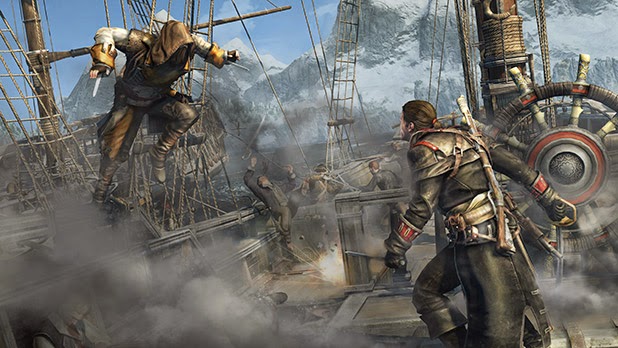 Cormac is a new recruit to the Brotherhood of Assassins, working under Achilles Davenport. Achilles sees potential in him, but Cormac develops an insubordinate streak that frustrates his mentors. Believing that taking a more active role in the Brotherhood's affairs will temper his impetuousness, Achilles orders Cormac with his newly acquired ship the Morrígan to track down a Templar cell that has been deciphering a Precursor artifact revealing the locations of several Pieces of Eden. The artifact, in the form of a wooden box, had been stolen from the Assassins following a massive earthquake in Haiti some years before. With the help of Benjamin Franklin, a Piece of Eden is located in Lisbon, and Cormac is tasked with retrieving it.
 However, Cormac has begun questioning the Assassins' motives after seeing their refusal to engage in dialogue with the Templars, and takes no satisfaction from killing an already-dying Templar commander,Lawrence Washington. His doubts come to a head in Lisbon, where his attempt to retrieve the Piece of Eden triggers an earthquake that destroys the city. Noting that similar events occurred in Haiti, Cormac is horrified to learn that Achilles and the Assassins intend to pursue the remaining Pieces of Eden. Cormac steals a manuscript necessary to interpret the artifact and flees, while the Assassins give chase. Confronted at the edge of a cliff in the homestead, he decides to commit suicide and bury the manuscript to the depths of the Atlantic than to let the Assassins reacquire it. Just as he jumps, an Assassin shoots him in the back; Cormac comes to believe it was his best friend Liam's doing.
 Cormac is rescued by a passing ship and taken to New York City. Once he recovers, he uses the skills he learned from the Assassins to drive out the city's criminal gangs. His actions attract the attention of George Monro, the city's governor, who offers Cormac the chance to help rebuild the city. Indebted to Monro, Cormac assists the British Army in their early campaigns against the French, and discovers that Achilles' chapter is supporting the French war effort. Monro reveals himself to be a Templar, and despite knowing of Cormac's prior loyalty, offers him a place within their Order. Cormac accepts, but Monro is killed shortly afterwards during an attack on a British fort. Cormac is then formally inducted by the Templar Grandmaster, Haytham Kenway.
 With the Assassin Brotherhood all but destroyed, Cormac is tasked with locating the artifact that was used to find the Pieces of Eden, as Achilles had passed to other Assassins prior to his Arctic voyage. Cormac's twenty year search eventually leads him to Versailles, where he discovers it under the care of Charles Dorian; father of Arno, protagonist of Assassin's Creed Unity. Cormac kills Charles and takes possession of the artifact, taunting the dying man with the promise that while the American Revolution ended Templar influence in the Americas, a new revolution may yet hold promise.
 In the present day, the player reconciles Cormac's memories. Under the direction of Otso Berg, a senior Templar leader, they upload them to the Assassin network, revealing how close Achilles Davenport came to destroying the world. The result is almost instantaneous, with the Assassins thrown into disarray and, as revealed in Assassin's Creed Unity, retaliating by hacking into the Abstergo's systems and destroying all of the company's Precursor samples as well as causing several of their servers to melt down. As reward for their actions, the player is presented with a choice; join the Templar Order, or die. The game fades to black before a choice is made.
 By March 2014, an Assassin's Creed game code-named "Comet" was revealed to be in development, set for release on PlayStation 3 and Xbox 360.[10] By the end of the month, additional reports indicated that "Comet" would be set around 1758 in New York, as well as feature sailing on the Atlantic Ocean. The game would be a direct sequel to Assassin's Creed IV: Black Flag, and would feature a Templar named Shay as the main protagonist. Haytham Kenway from Assassin's Creed III and Adewalé from Black Flag would also make appearances.[11]
 The game was officially announced on August 5, 2014, following a leak of the title.[12] Game director Martin Capel described the game as finishing the series' "North American saga" and that the game was designed to accommodate specific fan requests, such as taking on the role of a Templar.[1] The game is intended to "fill the gaps" of the story between Assassin's Creed III and Assassin's Creed IV: Black Flag and has "a crucial link" to the events of the previous games.[8] In addition to Ubisoft Sofia's work on the game, contributions are also being made by Ubisoft studios in Singapore, Montreal, Quebec, Chengdu, Milan andBucharest.[1] Ubisoft also stated that the game was being envisioned without multiplayer components "at this stage", but did not rule out any modes being added after the game launched.[13]


 Assassin's Creed Rogue received mixed reviews. Aggregating review websites GameRankings and Metacritic gave the PlayStation 3 version 74.06% based on 32 reviews and 72/100 based on 52 reviews,[14][18] and the Xbox 360 version 73.13% based on 27 reviews and 72/100 based on 32 reviews[15][19] and the Microsoft Windows version 69.71% based on 7 reviews and 75/100 based on 22 reviews.[16][17]
 Daniel Krupa from IGN gave the game a 6.8/10. He praised the engaging story, the nuanced lead character, atmospheric scenery, but criticized the lack of Templar abilities included, bland encounters with other main characters, uninspired side quests, empty world, as well as the frustrating combat and traversal system, which he stated has shown no improvements. He also criticized the game for not encouraging the player to explore the world.[27] Mark Walton from GameSpot gave the game a 6/10, criticizing the predictable story, unlikeable lead character, lack of interesting missions, as well as being thin on core content. He stated that the game feels like a glorified Black Flag DLC pack and has done nothing to put the franchise forward.[25] Xav de Matos from Joystiq gave the game a 6/10, criticizing the game for not adding anything new to the franchise. He stated that "Assassin's Creed Rogue is essentially a clone of Black Flag's setting and systems. If you can accept rampant copy-and-paste in another full priced entry, you'll more than likely enjoy whatAssassin's Creed Rogue has to offer."[28]